
By Comfort Nmaah Adongo
The New Patriotic Party’s (NPP) Upper East Regional Communications Officer, Dr. Samuel Akonga, has launched a blistering critique of the government’s economic management, accusing the administration of merely rebranding its flagship “24-hour economy” policy into a “new economy” without introducing substantive changes to its underlying policy pillars.
Upper East Regional Communications Officer demands verifiable job figures from the Finance Ministry, questions 2027 budget allocations, and challenges the status of stalled Agenda 111 hospitals, the regional stadium, and road works.
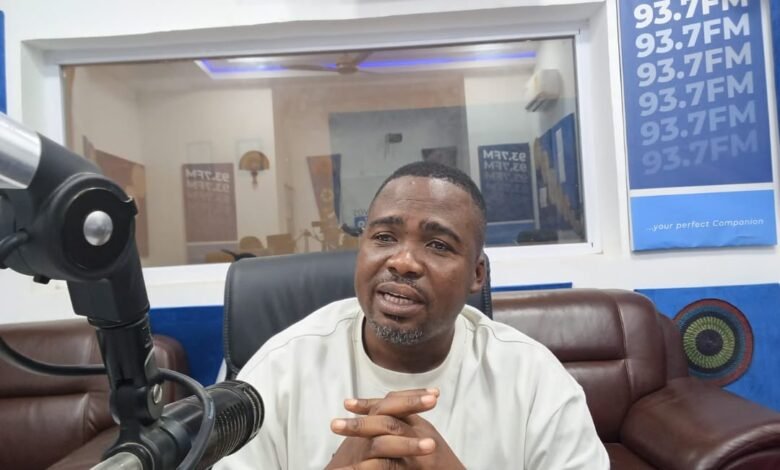
Speaking during an extensive interview on Blue Waves Radio’s flagship morning show in Bolgatanga, Dr. Akonga asserted that the subtle shift in official nomenclature represents a calculated attempt to deflect public scrutiny from the policy’s failure to deliver tangible employment opportunities across the country, particularly in northern Ghana.
According to the regional communications officer, a close examination of recent government communications reveals that while the terminology has evolved from a “24-hour economy” to a “new economy,” the core structural framework and operational pillars remain identical. He argued that citizens are looking for measurable economic relief and sustainable livelihoods rather than what he characterized as cosmetic linguistic adjustments.
Demand for Verifiable Job Data and Fiscal Scrutiny
Central to Dr. Akonga’s critique was a direct challenge to the Minister for Finance to publish a comprehensive, region-by-region breakdown of the jobs created since the inception of the 24-hour economy initiative. He emphasized that residents of the Upper East Region deserve to know precisely how many young people have been absorbed into formal or informal shift-based employment as a direct result of state interventions.
”We cannot continue to govern on slogans and shifting labels,” Dr. Akonga stated during the broadcast. “If the government insists that the 24-hour economy has been a success, the Finance Minister must come forward with verifiable data. How many jobs have been created nationwide, and specifically, what is the exact figure for the Upper East Region?”
Looking ahead to the upcoming fiscal cycle, Dr. Akonga also questioned the prudence of continuing to allocate public funds to the 24-hour economy secretariat in the 2027 national budget. He argued that maintaining administrative overhead for a secretariat whose output remains largely invisible to the average taxpayer constitutes a misallocation of scarce national resources at a time when critical sectors are starved of capital.
Beyond macroeconomic policy, Dr. Akonga pointed to stark operational realities on the ground in the Upper East Region that undermine the feasibility of a round-the-clock commercial environment. Foremost among these, he noted, is the prevailing security situation, which continues to dictate business hours across major towns and transit corridors.
He cited the petroleum retail sector as a prime example, noting that several fuel filling stations in the region are compelled to cease operations and lock their gates by 10:00 p.m. each night due to persistent fears of armed robbery. Until law enforcement capacity, street lighting, and night-time security patrols are drastically strengthened, he argued, expecting private enterprises to remain open overnight is both unrealistic and hazardous.
Furthermore, Dr. Akonga cautioned government communicators against inflating the perceived impact of the policy by claiming credit for sectors that have historically operated continuously out of sheer necessity. He pointed out that essential public servicesmost notably healthcare facilities and state security agencies have always run on a 24-hour shift system long before the current policy was conceived.
”Healthcare workers and security personnel have worked around the clock since independence,” he noted. “Counting doctors, nurses, and police officers on night duty as beneficiaries or creations of a new economic policy is intellectually dishonest.”
Stalled Infrastructure: Agenda 111 and the Regional Stadium
Turning his focus to physical infrastructure, Dr. Akonga accused the administration of failing to honor key developmental commitments made to the people of the Upper East Region. He challenged the government to provide an honest status update on the Agenda 111 district hospital projects, asserting that an earlier assurance to complete 10 hospital facilities within the 2026 calendar year had not been fulfilled.
In light of that missed benchmark, Dr. Akonga expressed deep skepticism regarding a newly announced target to complete 35 facilities, describing the revised projection as unrealistic given the pace of work observed across project sites.
He also turned the spotlight on sports infrastructure, referencing paragraph 1105 of the 2026 national budget statement, which outlined plans for the construction of a modern stadium in the Upper East Region. Dr. Akonga demanded to know why tangible progress had yet to materialize on the ground and raised concerns over the technical specifications of the proposed edifice.
Specifically, he argued that the planned 5,000-seat capacity for the facility is grossly inadequate for a rapidly growing region with a vibrant sporting culture and large civic gatherings. Building a stadium of that size, he warned, would result in an outdated facility upon completion, failing to accommodate future regional, national, or international events.
Concluding his intervention on road infrastructure, Dr. Akonga directly contradicted recent accounts suggesting steady progress on a major constituency ring road project in the region. Recounting a personal inspection tour of the stretch conducted just a day prior to his radio appearance, he revealed that while heavy earthmoving machinery was visibly parked along the corridor, the site was completely devoid of active workers or supervising contractors.
He warned against what he described as “optics-driven development,” where equipment is stationed on project sites merely to create the impression of ongoing construction without actual civil engineering work taking place.
Dr. Akonga wrapped up his remarks by urging the government to abandon political spin and engage the people of the Upper East Region with candor, calling for a transparent audit of all uncompleted projects and a clear, funded timeline for their delivery.
Source: Mybluewavesonline.Com/ Maurice Duncan/ Bolgatanga


