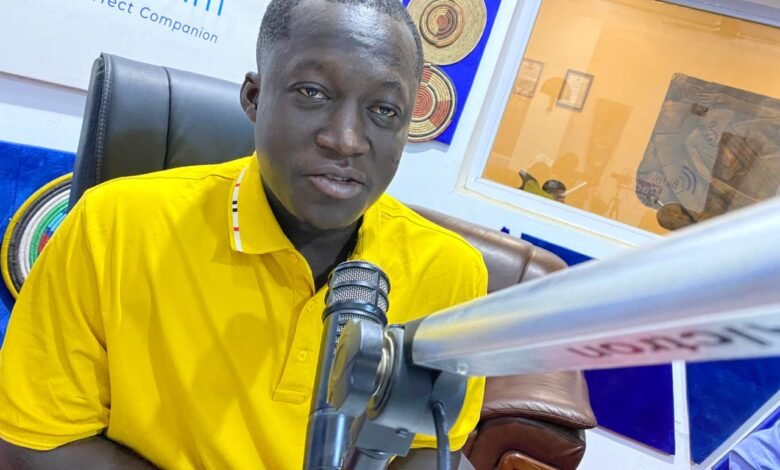
The stark contrast in road infrastructure development across political regimes took center stage on Blue Waves Radio (93.7 FM), with the opposition New Patriotic Party (NPP) accusing the ruling National Democratic Congress (NDC) of systematically deprioritizing the Upper East Region.
Speaking during a political show on the Bolgatanga-based station, Joseph Abonenga, Deputy Communications Officer for the NPP in the Bongo Constituency, argued that the condition of the region’s primary road corridors has escalated beyond politics into a pressing crisis affecting local livelihoods, healthcare delivery, and safety. Abonenga urged political leaders to remove “petty politics” from what he described as a fundamental development issue, emphasizing how bad road networks directly hamper economic activities and emergency medical transport across Bongo and the broader Upper East Region.
Anchoring his claims on official government figures, Abonenga directed listeners to page 74 of the 2026 National Budget Document to highlight the progress of a key road stretch in the region. He stated that while the NPP advanced the specific road project from 0% to 95% completion in eight years in power, the NDC achieved 0% progress over its eight years in office from 2009 to 2016, combined with zero visible progress during two years of the current administration, making a total of 10 years of inaction.
“Don’t take my word for it; go to page 74 of the 2026 budget. The 95% completion figure is documented right there in black and white,” Abonenga stated on air. He added that the 2016 budget explicitly recorded progress under the NDC at 0%.
Critiquing the current administration’s performance two years into its term, Abonenga asserted that the government has failed to deliver a single transformative project for the Upper East Region. He defined a “remarkable project” as one requiring at least four years of execution, arguing that because no major contracts have been awarded or signed to date, any near-future announcements would amount to late-term political maneuvering.
Abonenga contrasted the stalled work in the Upper East with ongoing infrastructure projects in the Bono and Brong enclaves. He alleged that the administration is concentrating development efforts in regions where elections were tightly contested to consolidate political support, while treating the Upper East as a “safe” electoral stronghold that can be overlooked.
Looking ahead to the 2028 general elections, the Bongo NPP officer framed the upcoming poll as a decisive test of loyalty for voters across the region. He questioned whether the people of the Upper East would remain loyal to a party that delivers zero progress or vote for visible development instead.
Abonenga expressed confidence that the electorate in the Upper East is increasingly discerning, predicting that voters will prioritize tangible infrastructure and proven developmental track records when making their decision at the polls.
Source: Mybluewavesonline.Com/ Maurice Duncan/ Bolgatanga