BOLGATANGA, UPPER EAST REGION — The Upper East Regional Hospital in Bolgatanga has successfully completed a major surgical procedure on a two-year-old boy born with a rare and complex congenital condition affecting his oesophagus and airway.
The child was diagnosed with oesophageal atresia with distal tracheo-oesophageal fistula, a condition in which the oesophagus—the tube that carries food from the mouth to the stomach—does not develop as a continuous passage, while an abnormal connection develops between the lower oesophagus and the trachea, or windpipe.
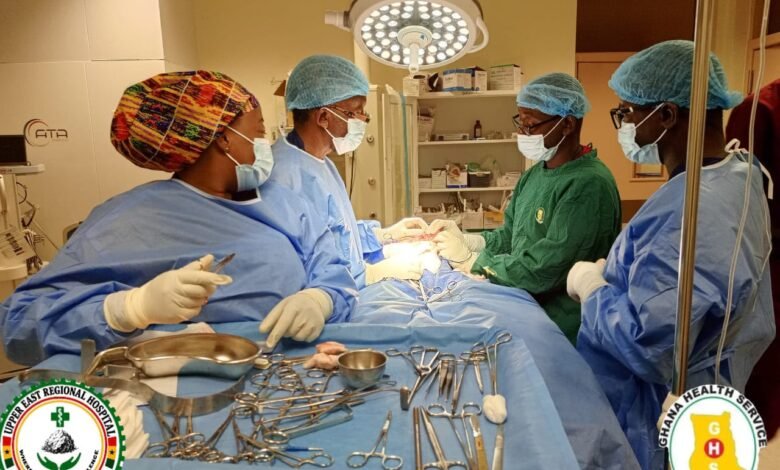
The complex operation lasted approximately five hours and was performed by a team of specialist paediatric surgeons, anaesthetists, operating theatre nurses and other healthcare professionals.
Following the procedure, the child is reported to be stable and remains under close observation by the surgical team.
A complex condition from birth
The child’s medical journey began shortly after birth. He was first seen by the hospital’s medical team at about three days old after presenting with excessive saliva, difficulty feeding and breathing problems.
Because the condition prevented him from safely swallowing food and saliva, the medical team first focused on stabilising his condition and treating an associated chest infection.
A staged surgical approach was subsequently adopted.
During the initial procedure, the upper portion of the oesophagus was brought out through the neck in an operation known as an oesophagostomy. This allowed saliva to drain safely rather than accumulate and enter the child’s airway.
A feeding tube was also inserted directly into the stomach through the abdominal wall, a procedure known as a gastrostomy, to provide the child with adequate nutrition without requiring him to swallow through the mouth.
The abnormal connection between the oesophagus and the trachea was also closed to prevent stomach contents from entering the airway and potentially causing further respiratory complications.
Following the initial intervention, the child stabilised and was discharged with regular follow-up.
Second stage of treatment
After several months of growth and medical monitoring, the child reached the appropriate stage for definitive reconstruction.
The latest surgery was aimed at creating a new pathway through which food could travel from the mouth to the stomach.
Because the original lower oesophagus could not be used for reconstruction, the surgical team used a segment of the intestine to create a replacement food passage. The procedure, known as intestinal interposition, involves using a suitable segment of the intestine to bridge the gap between the upper oesophagus and the stomach.
In cases where the colon is used, the procedure is commonly referred to as colon interposition.
The reconstructed passage is brought through the chest and connected to the oesophagus in the neck, with the ultimate objective of establishing a continuous route through which the child can eventually take food orally.
Child remains under close monitoring
The immediate period following such a complex operation is critical. The child is therefore being closely monitored by the surgical and paediatric teams as he continues his recovery.
Once the medical team is satisfied that the reconstructed food passage is functioning properly and the child has recovered sufficiently, plans will be made to gradually transition him from tube feeding towards oral feeding.
The recovery process will require continued monitoring, nutritional support and rehabilitation.
Collaboration behind the successful procedure
The successful operation was carried out by Dr. Lawrence Kankpeyeng, Paediatric Surgeon, with support from Dr. Hope Glover-Addy, Consultant Paediatric Surgeon at Korle-Bu Teaching Hospital, and Dr. Ernest Kunfaa, Paediatric Surgeon at the University of Technology and Applied Sciences (UTAS).
The team was supported by operating room nurses, anaesthetists and other healthcare professionals who contributed to the procedure and the child’s care.
The collaboration highlights the importance of multidisciplinary teamwork and professional cooperation in the management of complex paediatric surgical conditions.
A treatment journey in stages
The child’s treatment has been carefully undertaken in stages because of the complexity of his condition.
The initial surgery shortly after birth was primarily aimed at protecting his lungs, ensuring safe feeding and stabilising his condition while allowing him to grow.
The latest operation represents a major step in the reconstruction of his digestive pathway and brings him closer to the possibility of feeding normally through the mouth.
The surgical team will continue to monitor his recovery and assess his progress towards oral feeding and rehabilitation.
Hospital commends medical teams and family
Management of the Upper East Regional Hospital has commended the paediatric, surgical, anaesthetic, nursing and other supporting teams for their dedication to the child’s care from the neonatal period through to the latest procedure.
The hospital also acknowledged the support of the Consultant Paediatric Surgeon from Korle-Bu Teaching Hospital, the Paediatric Surgeon from UTAS and the cooperation of the child’s family throughout the treatment process.
The successful procedure underscores the hospital’s commitment to providing specialised, quality and compassionate healthcare, particularly to children requiring complex surgical interventions.
The hospital says further updates will be provided as the child’s recovery progresses.
Source:Mybluewavesonline.com|Maurice Duncan| Bolgatanga